One Stage, Every Story: How Theater Companies Are Redefining What American Community Looks Like
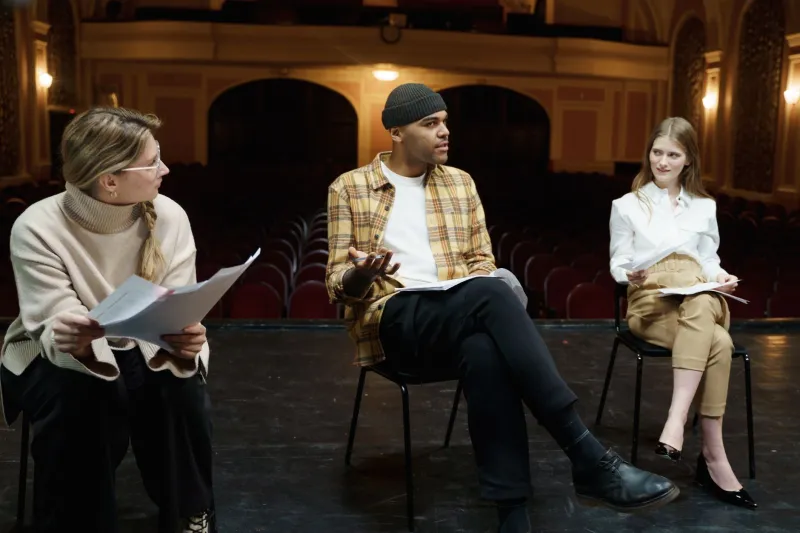
There is a rehearsal happening right now in a church basement in Ohio, a converted warehouse in Portland, a high school auditorium in rural Mississippi. A sixty-seven-year-old retired postal worker is coaching a nervous nineteen-year-old on breath control. A woman who uses a wheelchair is blocking her entrance for the third act with the precision of a seasoned professional. A recent immigrant, still learning the rhythms of English, is discovering that timing—comic or dramatic—transcends language entirely.
None of them auditioned for the same reasons. None of them would have crossed paths otherwise. And yet, here they are: an ensemble.
This is not an idealized portrait. This is Tuesday night at your local community theater.
The Sorting of America—and the Stage That Resists It
Sociologists have spent the better part of two decades documenting a troubling trend in American civic life: we are increasingly surrounding ourselves with people who look, earn, vote, and worship as we do. Residential patterns, social media algorithms, and the slow erosion of shared public institutions have conspired to narrow the circles in which most Americans move. The bowling leagues Robert Putnam once mourned are gone. Many houses of worship have aged into demographic monocultures. The workplace, for those fortunate enough to have one, often clusters people by education level and professional identity.
Against this backdrop, the community theater company stands out as something genuinely unusual—a space that is structurally resistant to sorting. The reason is practical as much as philosophical: theater requires people. Lots of different people. A production of Our Town needs a Stage Manager and a grieving mother and a chorus of townspeople and someone to manage the props and someone else to run the light board. No single demographic slice can fill all those roles, and no director worth the title would want them to.
The result is an accidental democracy, one built not on good intentions alone but on the hard logistical demands of putting a show on a stage.
Age Is Not a Barrier—It Is an Asset
Perhaps nowhere is this more visible than in the way community theater dissolves the generational walls that elsewhere seem impenetrable. American social life has become remarkably age-segregated: children inhabit schools, young adults cluster in certain neighborhoods and industries, retirees migrate toward communities designed specifically for them. Meaningful intergenerational contact—the kind that builds mutual understanding rather than merely tolerance—has become genuinely rare.
On the rehearsal floor, those walls simply do not hold. A seventy-two-year-old character actor brings lived experience to a role that no acting conservatory can teach. A twenty-two-year-old brings physical energy and digital fluency that reshapes how a production thinks about its audience. When these two people share a scene, something more than theatrical chemistry occurs: they begin, often without realizing it, to understand each other's worlds.
Directors at community theaters across the country regularly describe this dynamic as one of the most quietly transformative aspects of the work. The hierarchy of the stage is not determined by age or seniority in the conventional sense. It is earned through commitment, presence, and craft—qualities distributed without regard to birth year.
Ability, Access, and the Expanding Definition of Performance
Community theater has also emerged, often organically rather than by design, as one of the more genuinely inclusive spaces for people with disabilities. This is not a uniform story—accessibility remains an ongoing challenge for many companies, both onstage and off—but the trajectory is meaningful.
Theatrical performance is extraordinarily broad in what it can accommodate. Deaf performers have anchored productions that use American Sign Language as a primary performance language, creating shows that reach both hearing and non-hearing audiences simultaneously. Performers with mobility differences have reshaped how directors think about staging, often producing more inventive blocking than a conventional approach would have generated. Neurodiverse performers have brought interpretive choices to roles that professional directors, trained in established traditions, would never have considered.
What community theater offers, at its best, is a framework in which difference becomes a creative resource rather than a logistical obstacle. The stage does not demand that everyone perform in the same way. It demands only that everyone commit to the shared project of telling a story.
Class, Income, and the Democratizing Power of a Cast List
American social spaces are profoundly shaped by economic stratification. Where we live, where we send our children to school, where we spend our leisure time—all of these are filtered through income in ways that most of us rarely pause to examine. Community theater is not immune to these pressures. Ticket prices, membership fees, and the cost of costumes and transportation can all create barriers.
And yet, the cast list of a typical community production tells a different story than most American social rosters. A software engineer from the newer subdivisions on the edge of town rehearses alongside a warehouse worker from the older neighborhoods closer to downtown. A retired teacher on a fixed income shares a dressing room with a young attorney who just made partner. The shared project—the script, the deadline of opening night, the mutual vulnerability of performing in front of a live audience—creates a leveling effect that few other social structures can replicate.
This is not to romanticize the theater as a space free of social complexity. Tensions around race, class, and representation are real in community theater as they are everywhere. But the structure of collaborative production creates conditions in which those tensions can be named, examined, and sometimes transformed in ways that isolated social bubbles simply do not allow.
Newcomers, Belonging, and the Particular Grace of the Ensemble
For people navigating a new city, a new chapter of life, or a new sense of self, community theater has long served as an unusually welcoming port of entry. The ensemble form demands that everyone show up, contribute, and be seen—not as a background figure but as a necessary element of a living whole. There are no bit players in a well-run community production. Every role, every crew position, every volunteer hour matters to the final result.
This structure has a particular power for those who feel invisible in other contexts. The retiree who left a career and lost a ready-made social identity. The parent whose children have grown and moved away. The newcomer to a town who does not yet know how to break into its social fabric. Theater offers all of them the same thing: a reason to show up on Tuesday night, a name on a rehearsal schedule, and colleagues who will notice if they are absent.
The Stage as Mirror
At Epic Theatre Center, we believe that theater is not merely entertainment—though it is certainly that. It is also one of the oldest technologies human beings have developed for understanding one another. The stage is a mirror held up not just to individual experience but to the full, complicated, contradictory texture of community life.
In an America that is struggling to find shared spaces, shared stories, and shared purpose, the community theater company may be doing something more important than producing plays. It may be modeling, night after night, what it looks like when genuinely different people choose to make something together.
The curtain rises. The ensemble takes the stage. Every one of them belongs there.