The Stage Reimagined: How Non-Traditional Casting Is Unlocking Deeper Truths in American Theater

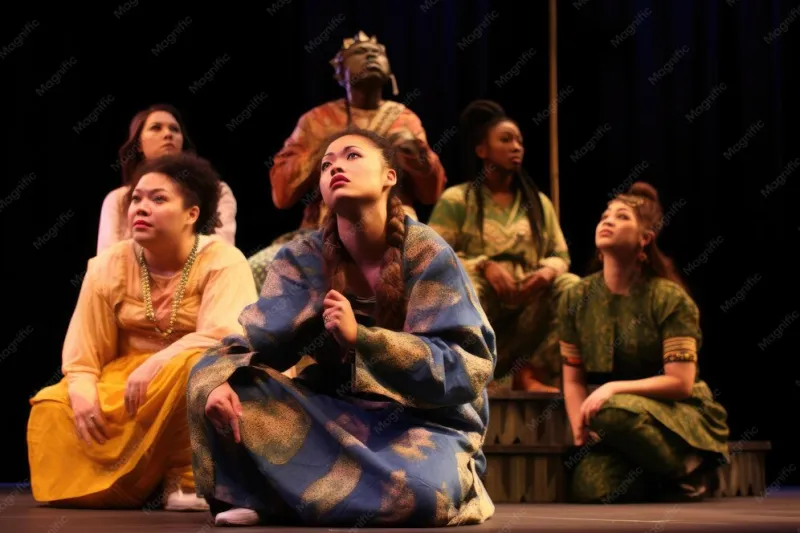
Photo: diverse theater cast rehearsal stage performance community, via cuttingball.com
In a mid-sized American city, a community theater company recently staged a production of a nineteenth-century American classic with a cast that bore little resemblance to what the playwright's original audiences would have seen. The lead role, historically portrayed by a white man of middle age, was played by a Black woman in her thirties. The ensemble included performers of multiple racial backgrounds, a deaf actor communicating through a combination of American Sign Language and spoken dialogue, and a range of ages that spanned from early twenties to late seventies.
The production received the strongest critical and audience response in the company's history.
This is not an isolated story. Across the United States, community and regional theater companies are engaged in a broad, serious, and sometimes contentious rethinking of casting practice—examining not only who is available to perform, but who should be performing which roles, and what interpretive possibilities open up when assumptions about identity and character are deliberately challenged.
Defining the Practice
Non-traditional casting is a term that encompasses several distinct but related approaches. At its most straightforward, it refers to the casting of performers in roles for which they were not historically or conventionally considered—a practice that has been advocated within the American theater community since at least the 1980s, when the Non-Traditional Casting Project, a nonprofit advocacy organization, began formally documenting and promoting the practice.
Identity-conscious casting goes a step further, treating a performer's specific background, experience, and identity not as incidental to their casting but as integral to the interpretive meaning of the role. A production that casts a Latina actress as Blanche DuBois in A Streetcar Named Desire and then actively incorporates questions of cultural displacement and code-switching into the production's conceptual framework is engaging in identity-conscious casting in its fullest sense.
There is also what practitioners sometimes call colorblind or color-conscious casting—terms that have generated significant debate within the field. Critics of the "colorblind" framing argue that pretending not to see race denies the real experiences that performers of color bring to their work and can inadvertently perpetuate the assumption that whiteness is the neutral default. "Color-conscious" casting, by contrast, acknowledges racial identity explicitly and asks what it contributes to the story being told.
Creative Breakthroughs on the Community Stage
The artistic case for non-traditional casting is, in many respects, the most compelling argument in its favor—and it is the argument most frequently made by directors who have committed to the practice.
When a performer's identity is in productive tension with the conventional expectations of a role, the audience is forced to engage with the material more actively. Assumptions that might otherwise operate invisibly are suddenly visible, and that visibility can illuminate aspects of a text that conventional casting would leave in shadow.
Consider the interpretive possibilities that emerge when a woman plays Willy Loman in Death of a Salesman, or when an actor with a physical disability plays Richard III without the role being framed as a metaphor for moral corruption. In both cases, the casting decision does not merely diversify the production—it asks the audience to reconsider what the play is actually about.
"Every casting decision is an argument about meaning," observed one community theater artistic director who has built a reputation for unconventional production concepts. "When we cast traditionally, we're making an argument. When we cast non-traditionally, we're making a different argument. The question is whether we're making our arguments consciously."
Challenges That Deserve Honest Acknowledgment
The practice is not without its complications, and thoughtful practitioners are candid about them.
One persistent concern involves the distinction between expansive non-traditional casting and what critics have called "casting tourism"—the use of diverse performers in roles that do not genuinely engage with their identities, serving primarily to signal the company's progressive values without producing meaningful creative or representational outcomes. When a theater casts performers of color in classical productions without any corresponding examination of the cultural assumptions embedded in those texts, the result can feel hollow to the very communities the casting was intended to honor.
There are also specific categories of roles where non-traditional casting requires particular care. Roles that are explicitly defined by a specific cultural or ethnic identity—characters whose particular heritage is central to their story—raise questions that are distinct from those posed by roles whose identity markers are conventional rather than essential. The theater community continues to debate where those lines fall, and there is no consensus.
For community theater companies with limited resources, there is an additional practical consideration: the work of doing non-traditional casting well requires ongoing investment in community relationships, performer development, and directorial preparation. It is not a policy that can be adopted by announcement. It is a practice that must be cultivated.
What It Asks of Audiences
Perhaps the most underexamined dimension of non-traditional casting is what it demands from the people in the seats.
Theater audiences carry expectations into the house with them—expectations shaped by prior productions, cultural habit, and the particular blindspots of their own experience. When a production challenges those expectations through casting, some audience members experience it as disorienting or even inappropriate. Others experience it as revelatory.
The most successful companies working in this space have found that audience preparation matters enormously. Program notes that contextualize casting choices, pre-show discussions that invite audiences into the interpretive conversation, and post-performance dialogue that creates space for honest response—these practices transform a potentially jarring moment into a genuinely educational one.
"We don't want our audiences to simply accept what they see," said one director whose company has made identity-conscious casting central to its artistic identity. "We want them to wrestle with it. That wrestling is part of the experience we're offering."
A Richer Mirror
At its best, non-traditional casting does something that theater has always aspired to do: it holds a mirror up to the full complexity of human experience rather than to a narrow and historically privileged slice of it.
For community theaters in particular, whose stated purpose is to serve and reflect their local communities, the alignment between this artistic practice and the institutional mission is clear. American communities are diverse in ways that conventional casting has long failed to represent. When the stage begins to look more like the audience—and when the audience begins to see itself in roles it has never before been invited to inhabit—something genuinely significant happens.
The stories do not become less universal. They become more so.