Open Doors, Open Stages: The Movement to Make Live Theater Truly Accessible
The phrase "the theater is for everyone" appears in mission statements, fundraising appeals, and curtain speeches at performing arts organizations across the country. But for millions of Americans — those with physical disabilities, sensory sensitivities, hearing or vision impairments, or limited financial means — that statement has too often functioned as aspiration rather than reality.
That is beginning to change. Slowly, imperfectly, but with genuine momentum, community theaters from New England to the Pacific Coast are dismantling the structural and cultural barriers that have kept significant portions of their communities at a distance from live performance. The results are reshaping not only who sits in the audience but what happens on the stage itself.
Understanding the Barriers
Accessibility in the performing arts is not a single problem with a single solution. It is a constellation of overlapping challenges, each requiring its own thoughtful response.
For audience members with mobility impairments, the most immediate barriers are often architectural. Historic theater buildings — many of which were constructed decades before the Americans with Disabilities Act established minimum accessibility standards — can present significant obstacles: narrow aisles, raised seating sections reachable only by stairs, restrooms that do not accommodate wheelchairs, and loading zones that make arrival and departure unnecessarily difficult.
For Deaf and hard-of-hearing audience members, the challenge is primarily communicative. A performance without American Sign Language interpretation or open captioning is, for many in this community, a performance from which they are effectively excluded — regardless of how welcoming the organization's stated intentions may be.
For autistic individuals and others with sensory processing differences, the conventional theater environment — its darkness, its sudden loud sounds, its social expectation of stillness and silence — can be genuinely overwhelming. Many in this community have simply stopped attempting to attend live performances after difficult early experiences.
And for the millions of Americans living at or near the poverty line, the cost of a theater ticket — particularly in urban markets where prices can reach well into the triple digits — renders live performance an impossible luxury rather than a cultural birthright.
Innovations Leading the Way
The organizations making the most meaningful progress on accessibility share a common characteristic: they have moved beyond compliance toward genuine hospitality. They are not asking what the law requires but what their communities deserve.
Sensory-friendly performances have emerged as one of the most significant innovations in accessible theater programming. These specially adapted productions — which typically feature reduced sound levels, modified lighting, designated quiet areas adjacent to the house, and explicit permission for audience members to move, vocalize, or leave and return as needed — have opened live performance to families and individuals who had previously found conventional theater inaccessible.
Theater organizations that have implemented sensory-friendly programming consistently report two outcomes: the performances are attended by audience members who have never before experienced live theater, and the experience of attending is described, by both first-time and returning visitors, as among the most meaningful of their lives.
Audio description services, which provide real-time narration of visual elements — staging, costumes, facial expressions, and physical action — through small receivers worn by blind and low-vision audience members, have similarly expanded access without altering the experience of other audience members. Organizations that have integrated audio description into their regular programming often find that the discipline of preparing detailed visual descriptions improves the production team's own understanding of what they are communicating through design and staging.
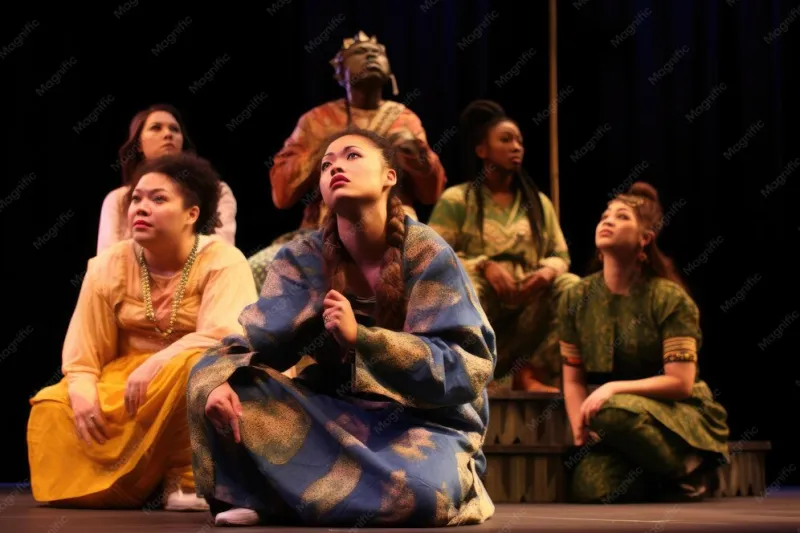
ASL-interpreted performances, meanwhile, have become a standard accessibility offering at many regional and community theaters. The best implementations go beyond scheduling a single interpreted performance per run — they integrate Deaf performers and ASL-fluent artists into the production itself, creating experiences that serve Deaf and hearing audiences simultaneously rather than sequentially.
The Economics of Inclusion
Financial accessibility remains among the most complex challenges facing community theater organizations. Production costs are real, and the revenue generated by ticket sales funds the work that makes community theater possible. There is no simple answer to the tension between institutional sustainability and the principle that financial circumstances should not determine access to cultural life.
The most innovative organizations are addressing this tension through a variety of models. Pay-what-you-can performances — in which audience members contribute whatever they are able to give, from nothing to the full ticket price — have proven both financially viable and community-building in ways that conventional pricing structures cannot replicate.
Community partnership programs, through which theaters work with social service organizations, schools, and community centers to distribute tickets to populations that would not otherwise attend, extend the reach of live performance without requiring individual audience members to navigate the often-intimidating process of requesting subsidized admission.
Some organizations have moved toward entirely free admission for specific performances or production runs, funding these events through grants, corporate partnerships, and individual donor campaigns. While this model is not universally replicable, it reflects a genuine commitment to the principle that the stage belongs to the whole community — not only to those who can afford to purchase access to it.
What Accessible Theater Teaches Us About Theater Itself
Perhaps the most important insight emerging from the accessibility movement in community theater is this: the practices that make theater more accessible also tend to make it better.
Audio description disciplines designers and directors to think more precisely about what they are communicating visually. Sensory-friendly adaptations require production teams to interrogate every technical choice — to ask whether a sudden loud sound or a blackout serves the story or merely startles. ASL integration invites new forms of physical expressiveness that enrich the work for all audiences. Pay-what-you-can models bring into the house communities whose perspectives and responses challenge and expand what theater companies understand their work to mean.
Accessibility, understood properly, is not a concession to limitation. It is an invitation to greater artistic rigor and deeper community connection.
At Epic Theatre Center, we hold as a foundational belief that the stage comes alive for everyone — and that "everyone" must mean something real. We are committed to building the practices, the partnerships, and the physical and programmatic infrastructure that make that belief more than a slogan. The work of accessible theater is ongoing, imperfect, and essential. It is, in the truest sense, the work of building a community.